
Choose wire thickness and plan connectors
Use AWG variants and a clear resistance example without treating it as a wiring rating.
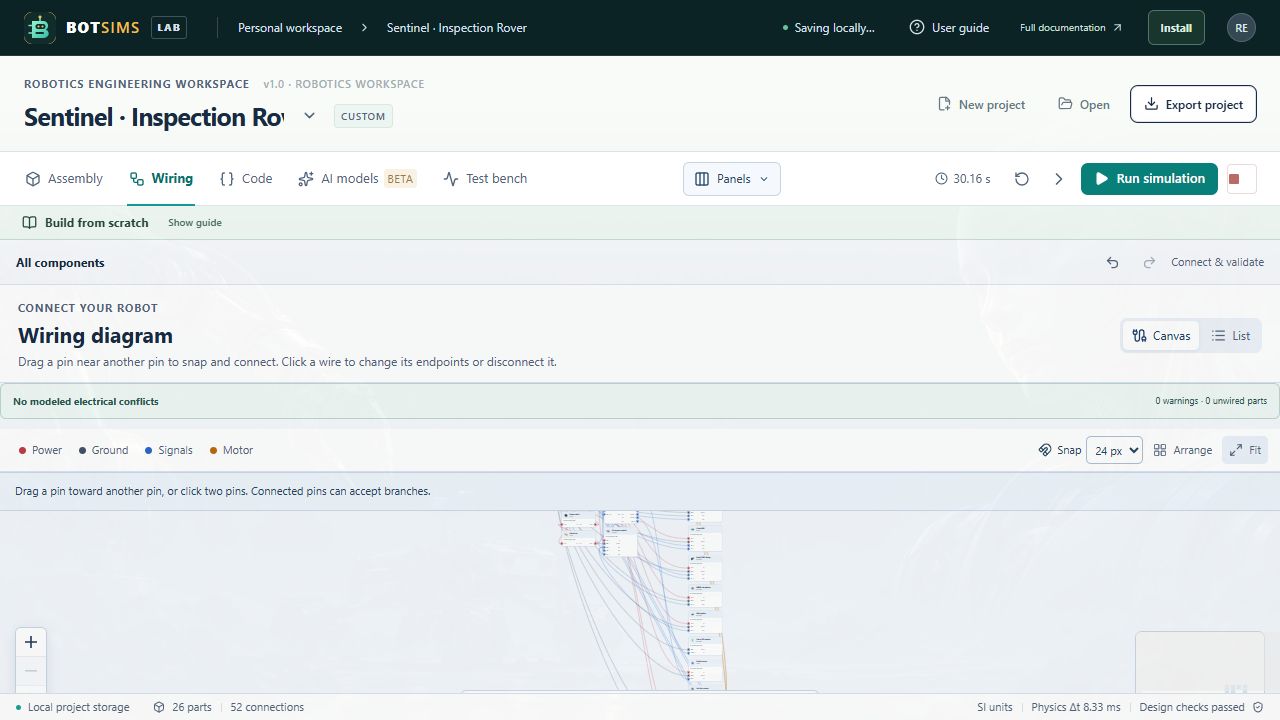
Wire and cable variants help plan the harness layout and bill of materials. Lower AWG numbers represent thicker nominal conductors. Inspect the actual component's diameter, length, and resistance-related parameters rather than inferring a rating from its rendered thickness.
Choose from nominal copper-wire entries at AWG 10, 12, 14, 16, 18, 20, 22, 24, 26, 28, and 30. In the inspector, Wire gauge (AWG), Length (m), and Insulated diameter (m) define that instance. Changing gauge updates the illustrative jacket diameter; gauge and length update nominal mass unless you supply an explicit mass override. The Wire DC estimate shows conductor diameter, copper area, and resistance for the selected settings; a Copper temperature override, when present, affects that estimate. Cable-layout variants without a copper gauge do not have this conductor estimate.
Conductor resistance: R = ρ × L / A
DC voltage drop:      ΔV = I × R
Resistive heat:        P = I² × R

Example only, using nominal 24 AWG copper:
R ≈ 0.0842 Ω per metre per conductor near 20 °C
1 m outgoing + 1 m return → about 0.1684 Ω
At 1 A: ΔV ≈ 0.1684 V and P ≈ 0.1684 W total
This example is a nominal resistance calculation, not an ampacity recommendation. Actual stranded construction, conductor material, temperature, insulation, installation, connector contacts, and allowed voltage drop change an engineering selection. These wire losses are planning estimates; changing a visual wire's gauge does not currently make the full simulation rail sag by that amount.
- Choose a wire/cable variant and place it to communicate the intended routing.
- Choose the intended connector family, pitch, pin count, and orientation from its model details.
- Add logical pin connections in Wiring; inspect any explicit pass-through pin mapping.
- Include both outgoing and return paths when doing a manual voltage-drop estimate.
- Review the exported bill of materials and verify the chosen physical hardware's datasheets before fabrication.