
Understand accuracy and physical limits
Use the equations meaningfully and recognize what remains outside this release.
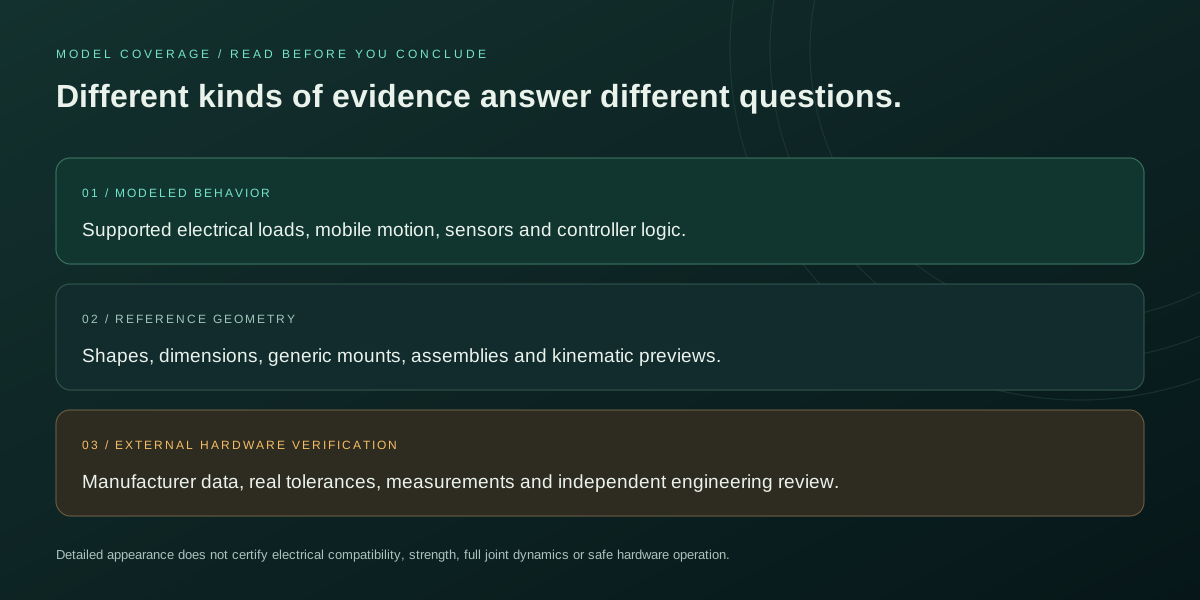
The supported model couples Rapier contact for mounted and loose assemblies to two DC motor windings, a battery equivalent circuit, a limited power/connectivity graph, and wiring-gated device observations. Its parameters are generic and have not been calibrated against your physical robot.
Battery:
  Vterminal = Voc(SOC) − I × Rinternal
  dSOC/dt   = −I / (capacityAh × 3600)

Supported DC motor:
  L × di/dt = Vapplied − R × i − Ke × ωrotor
  τrotor    = Kt × i
  τoutput   ≈ gearRatio × efficiency × Kt × mean(i)

Traction and motor heat:
  Drive force ≈ τoutput / wheelRadius
  Pcu         = R × mean(i²)
  Cthermal × dT/dt = Pcu − (T − Tambient) / Rthermal
The battery rail uses a bounded operating-point solve; the winding response and lumped thermal response are integrated with documented approximations. Switching is averaged. Available traction is limited by a simplified friction envelope. Payload adds mass at the root rather than a fully placed deformable load.
| Included | Current boundary |
|---|---|
| Compound rigid-body motion/contact | No independent rolling-wheel joints, arbitrary articulated robot dynamics, flexible structures, or structural stress analysis. |
| Two supported DC drive motors | No independent free-spinning wheel/rotor dynamics, arbitrary motor controllers, or automatic transmission meshing. |
| Battery sag, loads, and generic protection | One equivalent battery source; no charging, aging, regeneration, or general SPICE circuit analysis. |
| Logical electrical nets | No PCB signal integrity, electromagnetic interference, or fully coupled cable/contact losses. |
| Supported range/IMU/encoder observations | Simplified sensing, sampling, and noise; no universal driver model for every catalog sensor. |
| Bounded JavaScript and AI actions | No original MCU instruction execution, ROS integration, arbitrary packages, or physical robot connection. |
| Detailed component appearance | Rendered meshes and simpler physics colliders have different levels of detail. |
| Microphone/speaker layouts | No sound propagation, live transcription, generated playback, or acoustic localization. |
Use results to explore design tradeoffs and software behavior. Before selecting hardware from a result, compare model values with the intended component data and validate against a measured physical reference. A larger-looking robot is not automatically a validated simulation of that scale.