
Plan gears, belts, chains, and mechanisms
Arrange transmission parts and distinguish layout formulas from active drivetrain physics.
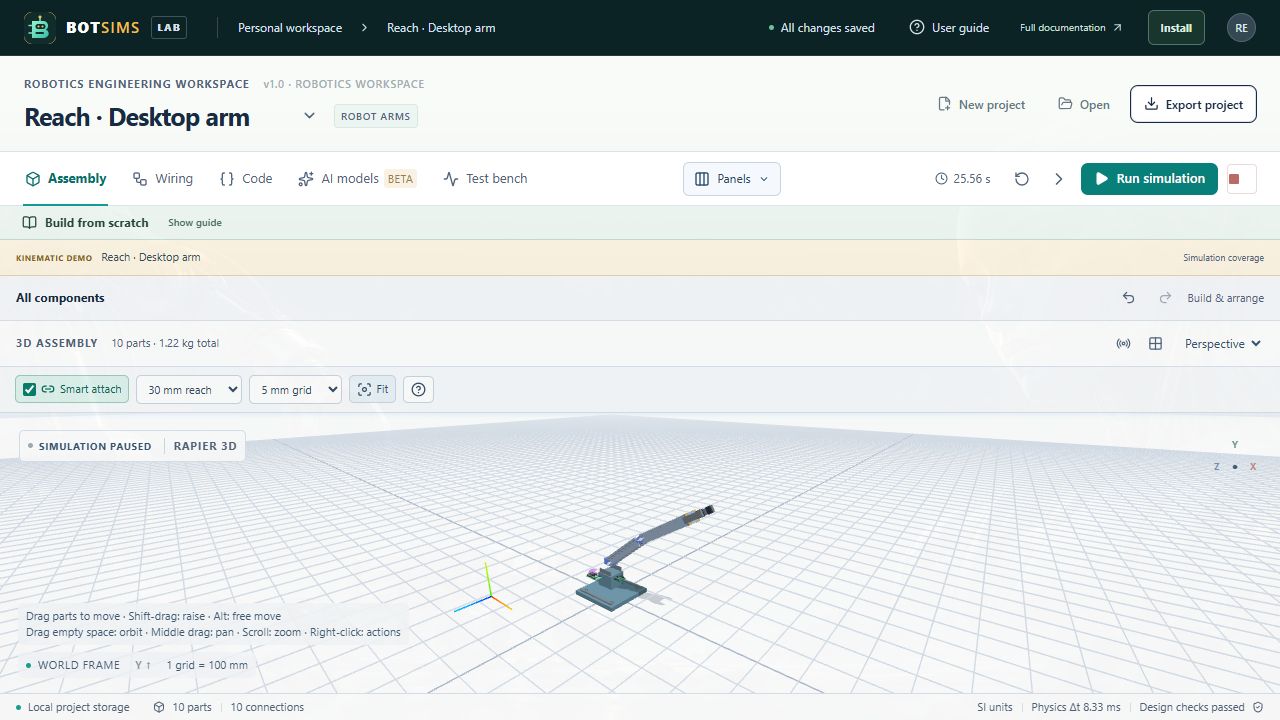
Transmission parts include different gear and pulley forms, belts, chains, sprockets, shafts, racks, and screw mechanisms. Use their detailed shapes, dimensions, and parameter descriptions to plan packaging. Place and rotate them with the inspector, including supporting bearings and mounts.
| Relationship | Meaning and boundary |
|---|---|
| Gear ratio = Ndriven / Ndriver | An ideal tooth-count ratio for a simple external gear pair. Rotation directions are opposite. |
| ωout = ωin / ratio | Ideal output speed for a reduction ratio greater than one. |
| τout ≈ τin × ratio × efficiency | A first-order torque estimate; real loading and losses require a suitable model. |
| Pitch diameter ≈ module × tooth count | Use consistent units for module and diameter. |
| Belt speed ≈ π × pitch diameter × rotations/second | An ideal no-slip relationship, using pitch diameter rather than the outside mesh diameter. |
For an exploratory ratio change in the working rover, edit the supported motor's gearRatio and efficiency. Keep wheelRadius consistent with the chosen wheel dimensions. Treat the resulting calculation as the documented motor/drivetrain approximation, not validation of the decorative transmission assembly.